An entry for the second edition of the International Encyclopedia of Communication Theory and Philosophy (Wiley):
This entry addresses the development of virtual reality since the 1980s as both an actual set of immersive digital media technologies, and as a technological imaginary of media, immersion, and the future of human-technological relationships inspired by these technologies. It explores the overlap between these two: between actual technologies and idealised, fictional or speculative visions of future media, and reflects on the concept of the virtual for digital media and communication.
The term “virtual reality” (VR) refers to a loose set of developments in computer media technology and applications that first came to popular attention in the late 1980s. It has also come to denote ideas and images about computer-generated worlds and realities, including actual VR applications across science-fiction film and literature, computer research, philosophy, and cultural theory. The extensive academic and journalistic attention to VR systems and predictions in the early to mid-1990s had faded by the turn of the century, but has revived in recent years with the development and marketing of new, inexpensive, and accessible VR devices.
Ideas about and predictions for VR have conjured up many different kinds of technologies and human–computer interactions since the 1980s, but the term VR has tended to settle around various instantiations of a persistent set of technologies: a head-mounted display (HMD) that fills the user’s vision with stereoscopic images of a computer-generated environment, an environment that can be navigated and interacted with through head movement, and data gloves or other input devices such as joysticks. Exceptions include CAVE systems, in which the user stands within a room-sized cube constructed from translucent screens. 3D computer-generated images are back-projected onto the screens. A CAVE user wears 3D glasses, which add to the illusion of immersion in space. At times appearing to promise something like a full engagement with the human sensorium, experimental and popular VR systems have tested and applied haptic force feedback in handheld controllers (popularized as “rumble” features in video-game controllers) or in the physical movement of the user through hydraulic systems (now used in entertainment simulators and theme-park attractions). The early 1990s saw a brief flurry of excitement over the erotic and pornographic possibilities of “teledildonics” via VR environments and haptic wearable devices, a phenomenon vividly imagined in the film Lawnmower Man (1992).
The two basic principles that characterize most VR systems predate computer technology. One, stereoscopic imagery, was a popular development in 19th-century photography. A studio shot, for instance, would be captured simultaneously by an apparatus made up of two cameras mounted side by side. The resulting images differed very slightly, according to the slight horizontal displacement in the position of the cameras. The two images would then be viewed through a special device, held close to the viewer’s eyes, within which mirrors allowed the left eye to see only the left image, and the right eye only the right image. Thus the device would simulate natural parallax vision as the user’s brain would interpret the two images as one, receding in space. The other principle built on the stereoscope’s immersion of the viewer’s peripheral vision. It could be experienced in mid-20th-century fairground or seaside pier attractions in which a movie loop was back-projected on a screen. The pleasure-seeker would stand close to the moving image so as to have his or her peripheral vision filled by the projection. The films were variations of a continuous unedited and subjective first-person shot, with the camera mounted on the front of a motorbike or roller coaster. The resulting experience was one of moving rapidly through space, and there was no visual reference beyond the image to anchor the viewer’s perception in the actual world. This principle underpins other “immersive” media, from panorama paintings to the IMAX cinema system.
Along with phenomenological and technical roots in popular technologies of spectacle, key aspects of VR as it is understood today were developed within computer science, for instance in the work on computer graphics and HMDs carried out from the 1960s on by the American computer scientist Ivan Sutherland. VR devices and systems as they are understood today were developed in the 1980s, with a notable contribution from Jaron Lanier and his virtual programming language (VPL) company. However, the popular and philosophical excitement around VR was driven by ideas about the future possibilities of a world in which virtual realities would be common or dominant at least as much as it was driven by actual technologies and experiences. Initially these systems were only to be found in research labs, or in a few art projects such as Char Davies’s Osmose (1995). As in the case of cyberspace, with which VR was often synonymous, emerging computer worlds and networked communications were inseparable from speculative technologies and experiences in science-fiction literature and cinema. “Cyberspace,” a term coined by William Gibson in his science-fiction novel Neuromancer (Gibson, 1984), came to refer to networked communications such as bulletin boards, e-mail, or the “space” of internet media in general; yet in Gibson’s books fictional cyberspace is much closer to subsequent developments in VR. His protagonists immerse themselves in abstract three-dimensional simulated worlds of data. In its early days VR proved fascinating to filmmakers too, no doubt in part because the VR imaginary is informed by the immersive experiences of cinema-going. In the 1990s, Lawnmower Man (1992), Johnny Mnemonic (1995), Strange Days(1995), eXistenZ (1999), and The Matrix (1999) all imagined a near-future blurring of actual and virtual realities in which protagonists’ bodily and cognitive existence is threatened by the immersive richness of the virtual world.
VR as both existing and speculative technology attracted considerable academic attention in the late 1980s and during the 1990s, though its discursive construction, and the concomitant imagining of its future trajectories, varied significantly. Some philosophers and media and communication theorists viewed VR as paradigmatic of a significant revolution in media technology and culture, toward cyberculture—an emerging technocultural order marked by ever more intense relationships between human bodies and minds and new technologies and networks. Others, while sharing this epochal assessment in spirit, argued that VR was primarily a media phenomenon, the teleological culmination of a long history and prehistory of human communication (Bolter & Grusin, 2000). From cave-painting and ancient theater to perspective drawing invented by Renaissance painters to panoramic painting and cinema, it was argued, visual and performative media have endeavored to immerse the audience’s attention and senses, filling the visual field and peripheral vision with increasingly convincing imagery, blurring the borders between the fictional and the actual world. Yet another approach saw VR as overlapping with the contemporaneous and deeply intertwined concept and technics of cyberspace. Howard Rheingold for instance followed up his influential book Virtual Reality (Rheingold, 1992) with a volume titled Virtual Community (Rheingold, 1993). Here the sensory immersion and synthetic 3D imagery were less important than the emergent online communities of the early Internet.
Perhaps the most far-reaching claims, or hopes, for VR were those emanating from the fusion of US West Coast hippie culture with the entrepreneurial drive of Silicon Valley. Jaron Lanier, one of the key technologists behind VR’s actual development, cast these technologies in radical science-fictional and utopian terms, predicting a future in which all dreams and fantasies could be (virtually) realized through headsets and interactive computer-generated animation. Some VR commentators and artificial-intelligence (AI) researchers, including the roboticist Hans Moravec, predicted the imminent digitization of human consciousness and the ability then to upload an individual’s consciousness to computer space, literally leaving the body behind. Other cyberculture critics have interrogated the conceptual and ideological assumptions behind these transcendental imaginings, noting for example the idealistic appeal of apparently leaving behind the “actual” world of social and economic inequalities (Featherstone & Burrows, 1996).
Exploring the various meanings of the word “virtual” itself can help explore the philosophical implications of VR as a concept and as a technology. On the one hand, there is the everyday sense of the virtual as something that is “nearly, but not quite” a particular phenomenon or state of being. As we might say that our decoration of a bedroom is “virtually” complete (i.e., not quite complete but very nearly so), so too VR seems very nearly real—but, again, not quite. It is experienced “as if” it were real (navigable, interactive, visible in three dimensions, perhaps tangible through haptic feedback), but evidently remains different from conventional lived reality. The virtual has a philosophical provenance as well, however—one that has been applied productively to the study of the digital worlds of VR and cyberspace. The work of Gilles Deleuze has proved particularly influential. Following Henri Bergson, Deleuze emphasized the temporal nature of reality and asked us to consider the reality of phenomena that have yet to come into actual existence, that have a future existence emerging from current realities—a capacity to be realized. The room will be completely painted, its completion has a reality in the present, but an inactual reality. Importantly, for Bergson and Deleuze both the actual and the virtual are real. Lister, Dovey, Giddings, Grant, and Kelly (2009) have applied this useful opposition between the virtual and the actual to digital media, including VR. Thus, they argue, a virtual world or cyberspace is real in that it is accessed through actual technologies by actual bodies and experience, but as a world it is virtual, not actual (Lister et al., 2009, p. 389).
The fevered early excitement around VR did not grasp this distinction, assuming that, with his or her hyperrealist computer imagery and immersive visual apparatus, the VR user stepped “through the frame” or screen of media, “entering” the representation (or simulation) and then controlling the action and the environment through interaction. For Lanier, VR meant the beginnings of a “postsymbolic” media culture. Jay David Bolter and Richard Grusin (2000) call this “immediacy,” a process by which the technological and cultural apparatus that mediates human experience with synthetic images and environments disappears from attention. This assumption—variously figured as a kind of living cinema or lucid dreaming—denied VR’s existence as a medium, as a technological system composed of hardware and software, and as a designed or coded representational world in which the possibilities open to the user were no more extensive or open-ended than in any other contemporaneous interactive application, such as multimedia CD-ROMs or video games. Cyberculture theorists critical of this idealist vision of VR often noted the persistence of an assumed fundamental distinction in Western philosophy between the mind and the body. This distinction has been undermined by neuroscience as well as by philosophy and critical theory, but it usefully describes the assumptions behind the most extreme predictions of a virtual future in which human consciousness is “uploaded” to computer networks and a simulated world, “leaving the body behind.”
From the late 1990s on the excitement around VR faded, partly because the actual experience of VR remained rare and the technology was expensive and cumbersome, less sophisticated versions being relegated to video-game arcades. More recently, however, three-dimensional dynamic worlds, remotely accessed via the Internet, became an increasingly popular everyday experience for millions of players, from massively multiplayer online role-playing games (MMORPGs) such as World of Warcraft to the creative and playful worlds of Second Life, Minecraft and Roblox. The conceptual excitement around virtuality has ebbed and flowed through the first few decades of the 21st century. The technical principles and terminology of VR itself returned to popular attention with the release of the Oculus Rift video-game system—a lightweight and affordable headset for immersion in video-game worlds. Oculus Rift was bought by Facebook in 2014 and soon faced competition from Google, whose Cardboard device invited users to construct a simple stereoscopic device using an app and a smartphone. Technological developments in “augmented reality” (AR) provided a boost, particularly when combined with the networked and mobile capabilities of smartphones in the 2010s. AR explicitly references VR, differentiating itself through its overlaying or insertion of computer data graphics over, or into, actual-world environments or video feeds. AR attempted popular commercial applications (e.g., the smartphone app Layar, the mobile game Pokémon Go, and the ill-fated Google Glass). In 2021 Mark Zuckerberg renamed Facebook’s parent company ‘Meta Platforms’ to flag up his aim to establish a ‘metaverse’—referencing 1990s cyberpunk via Neal Stephenson’s book Snow Crash. Building on a VR app called Horizon Worlds and foregrounding VR and AR hardware, he planned to replace established social media and other online communication with a universal 3D world. Again, teleological visions of VR immediacy met the physical, cultural and embodied realities of everyday media communication, and the metaverse was quietly shelved, along with losses in the tens of billions of dollars. The main commercial focus for VR now is videogaming, with Oculus, HTC, Valve, Meta, Apple and Sony releasing new gaming headsets through the late 2010s and 2020s.
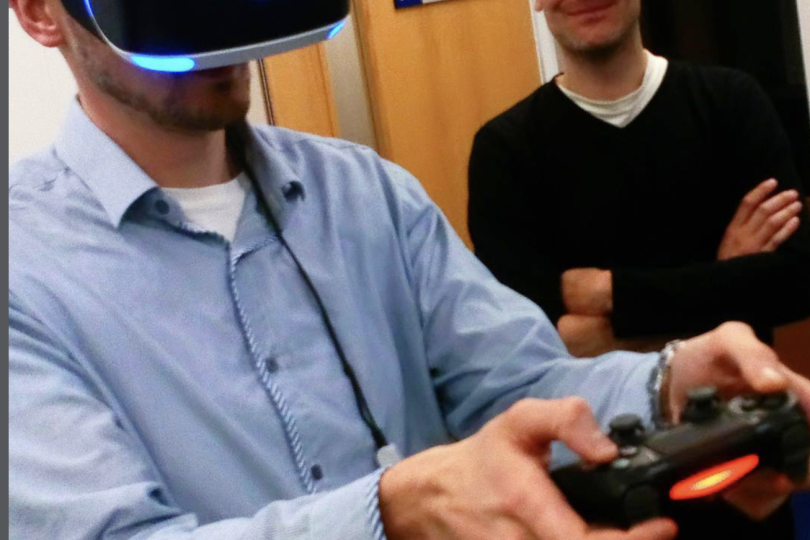
At the time of writing, images of people wearing VR headsets are often seen in publicity for museums, visitor attractions and universities, yet there is evidence of widespread, everyday and persistent use of VR applications beyond gaming.
SEE ALSO: Augmented Reality; Cyberspace; Interactivity; Remediation
References and further readings
Bolter, J. D., & Grusin, R. (2000). Remediation: Understanding new media. Cambridge,MA: MIT Press.
Featherstone, M., & Burrows, R. (1996). Cyberspace/cyberbodies/cyberpunk: Cultures of technological embodiment. London, UK: Sage.
Gibson, W. (1984). Neuromancer. NewYork, NY:Ace.
Lister, M., Dovey, J., Giddings, S., Grant, I., & Kelly, K. (2009). Newmedia: A critical introduction (2nd ed.). London, UK: Routledge.
Rheingold, H. (1992). Virtual reality: The revolutionary technology of computer-generated
worlds—and how it promises to transform society. New York, NY: Touchstone.
Rheingold, H. (1993). The virtual community: Homesteading on the electronic frontier. Reading,
MA: Addison-Wesley.
Stephenson, N. (1992). Snow Crash. New York, NY: Bantam.