Whisper your decisions, dictate your instructions, and proclaim your victories to it […] Nothing could be more useful, and nothing more useless: when the technical process is given over to a magical type of mental practice or a fashionable social practice, then the technical object itself becomes a gadget.[i]
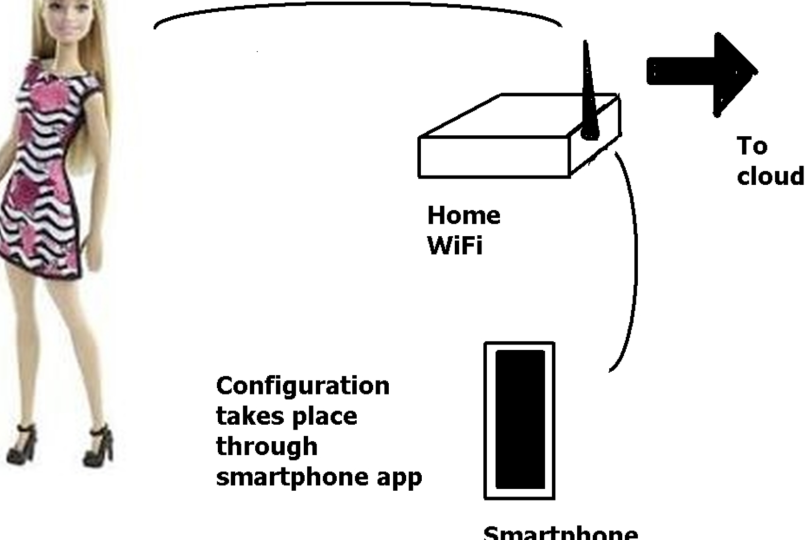
Here Jean Baudrillard allegorises late capitalist technoculture in the form of the Dictaphone, an analogue tape-based handheld and portable audio recording device. Though translated here as ‘gadget,’ in French the term he uses is machin, derived from machine. Hence it carries connotations of a degrading or decaying of the productive machine to an indistinct and throwaway object. For Baudrillard the machin epitomises the catastrophic implosion of technological use value in a commodified everyday and the subjective states it demands. What if though, we worked with his emphasis on the intimate, tactile register of this technocultural encounter, but shifted our perspective to that of the toy-like? What if the ‘useless’ were considered a quality and an aspiration, not a curse? What if ‘magical mental practices’ and ‘fashion’ were considered intriguing as well as problematic? What if the event instantiated when a hand and an imagination grasps a device – with its intimate whispering – were considered playful in the generative, unstable, pleasurable sense, rather than as merely the realisation of a commodified interpellation? What kind of machin is a Wi-Fi connected Barbie, one that can record and share the child’s whispers, both with parents and, controversially, the toy’s proprietary owners?[ii] Any assessment of its imaginative pleasures and ethical dangers – whether local to the child’s immediate circumstances or global in its implications for privacy and data mining – must attend less to the toy/system as a set of signifiers or as an abstract ‘commodity’, and more to its reality and potential as technological, its capacities and processes, its incorporation into transmedia networks that are surveillant as well as symbolic.
[This is taken from the first draft of Toy Theory: technology and imagination in play (MIT Press 2024) – I had to cut 30,000 words and this didn’t make the final version]
[i] Jean Baudrillard, Cool Memories (London: Verso 1990), 77; see also Martin Lister, Jon Dovey, Seth Giddings, Iain Grant and Kieran Kelly, New Media: A Critical Introduction (London: Routledge 2009), 252-3.
[ii] Giovanna Mascheroni and Donell Holloway, eds. The Internet of Toys: Practices, Affordances and the Political Economy of Children’s Smart Play (Palgrave Macmillan 2019).